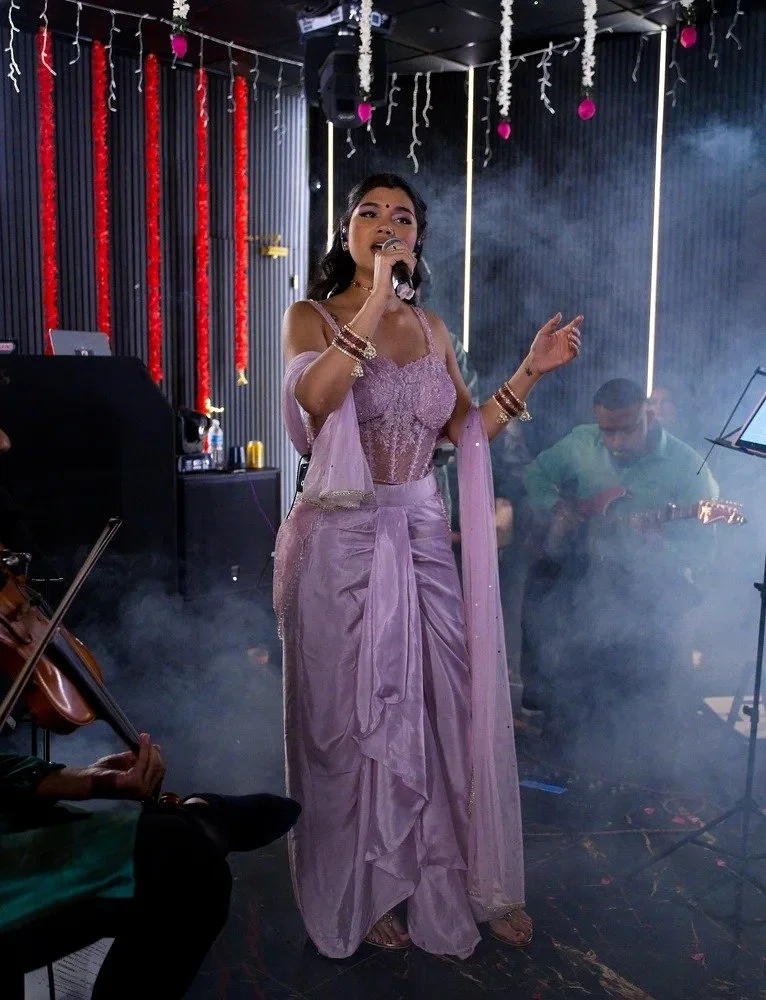
Photo credit: Maharani via Spotify
Interview by Tara Saraf
London-based, Tamil singer Maharani’s blend of her Eastern and Western worlds first appeared on my radar with the 2022 single “Feel.” Its melancholy, multilingual vibe was refreshing to hear and last year’s album, Shakti, meaning strength, featured many enriching collaborations with UK artists such as Saloni on “Deewani”, Henjila on “Red Lotus”, and of course, her longtime collaborator and partner, ItsyaboiKay. On this project, Maharani wanted to explore the concept of womanhood and delve into spirituality. Maharani, or Nivedita, was born and raised in the Netherlands to Tamil parents up until the age of eight, when she moved to England. Her parents, who grew up in Mumbai, spoke to her in English, which eventually became her main language and the producer Kay, or Krittikan, is fluent in Tamil. Through music, Maharani is able to connect to language in a nuanced manner. I caught up with the multi-hyphenate artist over Google Meets to discuss her creative process and her goal of making South Asians feel more confident in their identities.
You started an initiative called Cinnamon & Spice that aims to nurture artists of South Asian descent and connect them to audiences worldwide. What can you tell us about the future of this initiative?
Cinnamon & Spice was at a time when South Asian culture was starting to make more noise in mainstream media. I think from when I started to now, it’s really taken off and there’s been so much growth in that space. We’ve seen so many different artists now that are coming to light and really getting to pick up space in big festivals and bigger platforms and stuff. I’m really happy to see that it’s not the only initiative out there. There’s a lot of independent organizations as well that are putting on different artists. Yeah, I guess if I wanted to do another event in the future with different artists, there’s so much talent here in the UK and in London…Kind of show everyone what the underground talent over here is. The playlist is still there on Spotify. It’s just one of the many different ways that [is] existing now for South Asian creators to be connected to South Asian audiences, because I think the demand is definitely there. People want to find new artists doing this kind of stuff. Likewise, the creators, we need to be able to find our audiences. So, yeah, I’m happy to be helping out with that where I can.
You've described your sound as “hybrid” as opposed to solely traditional. How do you go about incorporating R&B and trap/soul with semi-classical Indian music and embellishing it with heartfelt, profound lyrics?
Well, thank you, first of all. I think it's interesting because, for me, I kind of approached creating music from a Western standpoint. When I started creating music it was always more R&B, hip-hop. Yeah, it’s always been kind of through a Western lens. I think it’s different when you kind of make, like, for example, like Indian cinema music, and then they go and they try and find more modern elements and bring that in. This is like approaching it from a different angle. R&B is probably the style that I’m most comfortable with. Same with my husband and producer Kay as well. That's kind of the genre– trap/soul, R&B– that we love to listen to and we love to create in. And separately from that, we have classical training. And when you train in it, it's like there's very specific rules for it. You're trained within that space, and then bringing that, coming out of that and thinking, okay, like “How can I do something more creative with this?” We'll bring it into a different genre. That is, I think, the challenge of it and something that we've kind of been experimenting with for the last couple of years.
Totally. It's been, you know, so amazing to see your growth as an artist and especially like, [how] you dropped Shakti last year. And then you appeared on 777, your husband's album, as well. And I noticed that [different] elements of nature regularly appear across your body of work. In what ways do you create sonic atmospheres that evoke lushness and serenity?
I love that question. That was a great question. I love that you picked up on the theme of nature, because I feel like within my kind of spiritual beliefs and like what I [try] to put out in my music, my lyrical themes…Even in Hinduism, a big part of it is nature worship, and learning to live in harmony with nature, worshiping the sun, worshiping the elements around you. If anything, that's why it's such a big part of my imagery and stuff as well. That's something that me and my husband share, like, we definitely kind of connect over that. I feel like it's just one of those things where, like, I don't really have to tell him much, he just kind of gets it when I tell him, like, “Okay, this is the kind of vibe that I'm going for.” Sometimes I kind of go in and I'm like, “This is the kind of concept that I have in mind. Let's create from there.” And other times it's like he would have already created something and I'm like, “I can see this evolving into something else.” So, yeah, I guess that's kind of how our creative process evolves.
Themes from 777 explore things that are linked to the exciting next chapter of Maharani and Kay’s journey. A highlight from this year was her June performance at SXSW London, where she adapted her songs and played rock renditions with an incredible band. “I love rock. That’s kind of what I grew up on. Funnily enough, the music that I used to make was more like rock-pop. It’s definitely always been kind of an inspiration.” It’s my honor to have stepped inside her world and experienced the mellifluous magic of Maharani.
STAY UPDATED WITH MAHARANI